Search This Blog

Showing posts with label Travelers Diary. Show all posts

Sunday, 29 July 2018

Biological Corridor and Communities in Bhutan, Connectivity at a crossroad

Neither too low into the tropical jungles, and nor too high touching the alpine mountains, but in between are the temperate hills adorned with cool broadleaved forests and mixed conifer trees. Neither a sacred sanctuary of wildlife with strict protections, nor an edge facing the adversity of multifarious modern development, but it is the landscape with purpose; of maintaining diversity, of sustaining community, and most indispensably, of securing connectivity. They are the biological corridors (BCs) of Bhutan, set aside to connect one or more protected areas (PA) and facilitate wildlife movement, first established in 1999, as a gift to the earth from people of Bhutan. Eight in numbers and covering 8.61% of Bhutan’s total area, the BCs together with the PAs today forms the Bhutan Biological Conservation Complex (B2C2), expanding over 50% of the country.
Pristine Forests of Biological Corridor 8 connecting JSWNP to WCNP, as seen from Black Mountains of JSWNP

While the BCs together with the PAs create a beautiful mosaic of a conservation area in Bhutan, little is known about the actual connectivity enabled by the BCs. Conservation funds increased manifolds in the PAs but the indispensable BCs remained neglected. Wildlife thrived in the protected sanctuaries but their status remains ambiguous in the BCs. Park community livelihood was diversified but little did we know that communities at the fringes of BCs were trying their best for the sympatric association with the wildlife around them.  

With an objective to assess the structural connectivity of BC for enabling tiger movement between the national parks, I embarked on a new conservation journey in the spring of 2018. My priority amongst the 8 BCs was for BC8 that is the often called the northern corridor, as it connects parks of central Bhutan like Jigme Singye Wangchuck National Park (JSWNP) and Phrumsengla National Park with protected areas in the north viz, Jigme Dorji National Park, Wangchuck Centennial National Park (WCNP), and Bumdeling Wildlife Sanctuary. Further, I concentrated my work in the portion of BC8 that connects JSWNP with WCNP encompassing an area of 240 sq.km. JSWNP together with Royal Manas National Park (RMNP) was found to be home to around 27 tigers and are described as a potential source population for tigers. The tiger, despite having records of going as high as 4500 masl, the density is much lower in WCNP and its adjacent northern PAs. The sound management of BC8 is vital for population dispersal of tigers from RMNP and JSWNP to northern PAs. I, therefore, felt it’s vital that the structural connectivity is assessed soon, least we know the functional connectivity. Being a Landscape Ecology and Nature Conservation graduate student, I felt the responsibility has befallen me, thus I took the determination to set out.
Late March 2018, researchers marching in snow in BC 8 (3800 masl)

Late March, yet the winter doesn’t seem to have passed the temperate forests of BC8. The first night we were out in the forests and the next morning, we found that we were shrouded under the thick blanket of snow. I was accompanied by two research assistants and two field guides who also served as porters, traversing the hills and meadows which were yet to sprout. In Bhutan, field survey works are strenuous with no access to roads and we have to always hire porters. As per my study design, I am required to cover the entire study area of 240 sq.km within a short duration of one month, to assess the landscape structure, prevalence of large carnivores like tiger and to ascertain the occurrence of ungulate species which are proxy of landscape structure for enabling migratory corridor for large carnivore like tiger. While I will scan the entire area for indirect wildlife evidence like pellets and droppings of sambar or deer and scats of tiger and other felids, I also took along a score of camera traps to be set up for remotely triggering to capture the real-time presence of the species. Besides, I also had to meet many yak herders from the communities in and around the BC to hear their stories on wildlife and to know their perception towards BC and conservation, as I learned that the designated BC 8 is indeed core winter grazing sites for the nomadic herders in Sephu, Wangdue Phodrang. From May until October for six months, the nomadic yak herders move to their summer pasture in alpine meadows of WCNP.

While the snow made environment serene, it wasn’t really a perfect moment for a wildlife surveyor. The forest trails were slippery and there was no hope to find wildlife evidence with snow layering the ground. So I led my team to a community of nomads to hear their stories of herding yaks and encountering tigers. Amongst the nomads was Mr. Wangdi, with whom I had an intense interaction. At the age of 53, Wangdi is at his best with the chores that revolve around his 60 plus yaks, together with his wife and daughter. His winter grazing site falls completely within the BC boundary but he is oblivious of it. Indeed, Wangdi does not have any clue about what biological corridor is. However, he knows a good deal about the tiger and other wildlife. Wangdi has been interacting with wildlife since his childhood days and definitely, he would be familiar with wildlife as he is with his yaks. Out of curiosity, I asked him how often he saw a tiger live but he seems to have not seen it once. “The big animal is an emanation of our local deities so it will be always difficult to see,” he said. The tiger kills, as per their traditional belief, was often attributed to some karmic misfortunes in the family because he says that tiger kills the yaks of a particular family despite all neighbors freely leaving their yaks in the same open forests.
One of the Huts of Mr. Wangdi in BC 8.

Besides the tiger, there are other predators as well in the region. The wild dogs in pack hunt down big yaks and common leopards often take away the young calves. The Himalayan black bear, on the other hand, snatches the kill from tigers, as narrated by Mr. Wangdi. The landscape with forest connectivity hardly disturbed, and with the prevalence of diverse large carnivores, humans and livestock foraying into it means only the inevitable incidents of predation. It is, however, not a new phenomenon but for millennia, our farmers and wildlife have fared well in mutual coexistence. The nomadic herders in the region traditionally practiced Bon-Choe, a religious practice of believing in spirits and local deities with many ridges, trees, and cliffs declared as the abode of the spirits and deities and revering them sacred. Such practice instilled positive affinity towards nature and wildlife by the herders. Today as the shamanistic practice dwindled, herders understand the deeper Buddhist values and they have general abhorrence towards killing, being considered great sin. These are the major determinants of herders’ positive attitude towards wildlife, which enabled the human-wildlife coexistence.  But with changing times and in the face of increased depredation cases, the much-cherished ethic might face an abrupt end.
Chimmi, Wangdis daughter seen milking one of her Bjims.

Being a park official myself, I am aware of the efforts that conservationists put to build community stewardship towards the environment and make them conservation partners. I asked Wangdi if he was ever engaged in programmes developed by conservation agencies for the herders’ welfare but he looked awfully clueless. This was expected as the BCs received lesser priority for management as of now because of many constraints. Wangdi was quick to mention about an ad-hoc monetary compensation that he received for a number of yaks that he lost to tiger a few years ago. Wangdi feels that the tiger and other predators are increasing now with increased protection of wildlife. He lost three sturdy yaks to the tiger during the last winter, which accounts to an economic loss of around USD 1363 at the current market value. “It is a big loss for me and government is not consistent with monetary compensations,” says Wangdi, cautioning he might give up herding in the face of increased predation and better income opportunities. Monetary compensations, anyway were meagre in comparison to the losses that herders suffer.  Once, a normal acceptable phenomenon, his traditional belief is now replaced with expectations, and his age-old tolerance may soon see the substitution by arrogance. After all, why would a nomad care about the endangered species when he receives no tangible benefits of conservation in his backyard?
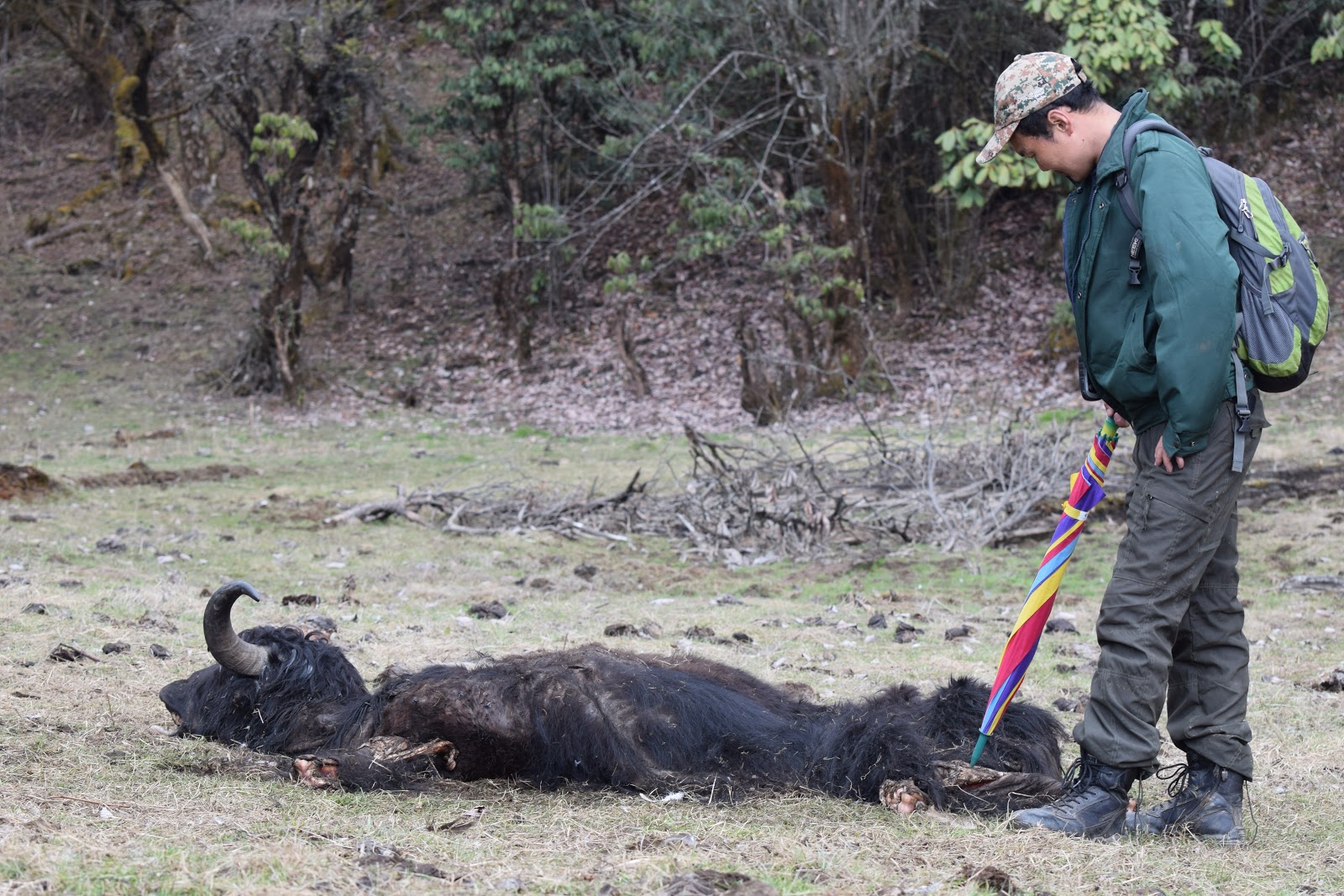
One of Wangdis yak succumbed to tiger injury in BC8, which was later feasted by bear and vultures.

By virtue of being a conservationist and a government official, it became my responsibility to share with him about the challenges that we face in pursuing conservation. Bhutan’s picturesque landscapes and rich biodiversity attracts high-end tourists, the revenue from which is shared by entire Bhutanese in the form of social services like free healthcare and education. Large cats like tigers are under constant threat from habitat loss and poaching, with the world population not more than 3800 individuals. Bhutan’s is lucky to harbour 103 of them, the number that thrived because of the harmonious coexistence between nature and our people. For a country like Bhutan, losing the tigers would also mean losing our rich cultural values. Tiger is the only animal that connects myth with reality in our Buddhist society. On the other hand, conservation in Bhutan is mostly donor-driven, and it is important that we make use of the fund in innovative ways than delivering measly monetary compensations. Biological corridors are vital for connecting the protected areas, therefore like people in the parks that foster to conservation needs, communities by the BCs will also form the ultimate connecting links.
The Stripe of BC 8 (May 2018)


The next three weeks, I continued with my field surveys and camera trap installation works, but recurring thoughts on the need to revive harmonious human-wildlife coexistence popped in my head. Neither do I want the landscape to be fragmented and tigers lost, nor do I want herders like Wangdi to suffer from predation and give up herding because sustaining both is a prerequisite of a vibrant connectivity. Will BC 8 serve as Corridor of Hope? 

Note: My research in the BC 8 was funded by the National Geographic Society and German Academic Exchange Programme (DAAD), with reassuring support from Department of Forests and Park Services (NCD and JSWNP).

Monday, 12 February 2018

Destination Europe XI: Last trip of 2017

Much of Europe has been traveled and it was already the end of 2017. New Year was awaited but I wanted to make my probably last Europe trip before 2018 during the Christmas and New year Holidays. This I planned because 2018 will mark my last year at the University and I wanted to dedicate my time for successful completion of the University stuffs, most important one being the Master Thesis. Central Europe! I call it. Acclaimed to be most beautiful cities and much talked after by the travelers, I visited three cities. 


 23. Vienna: The capital city of Austria, which I am quite familiar with the name because many senior foresters graduated from a University in Vienna and also I have two of my forester friends studying there, learnt that the third friend was also not a stranger but a fellow blogger and an artist, with whom I occasionally converse. This is a plus point as I don't have to book hostels but to squeeze in their apartments and act like an important guest. I have informed my fellow foresters in Vienna about my travel plans and persuaded them to take a trip further with me as I have planned to visit the neighbouring cities too. 24th December, just before the Christmas I booked my travel and it was a tiring 15 hours journey in Bus from Greifswald to Vienna but worth a travel. 


I was warmly received at the station by one of my friends Rinzin who is a brotherly elder and senior Forester. He escorted me to their home and reaching their place gave even a warmer sensation of being at home. Four of them, two foresters and two layers were residing in the same house and sharing their meals together like a happy family. Being the lone Bhutanese, occasionally I use to have a strong feeling of loneliness and fondly miss my home. That day, however, was special with a special Bhutanese dish, jokes, gossips, and lot of laughter. The following day happened to by the Winter Solstice and it was yet again a pleasant surprise to have porridge early in the morning and begin the beautiful day contended. Later, my hosts in Vienna took me on a city sightseeing, but more than the eagerness to see the wonderful Vienna, I felt cozier talking with them and relaxing. 
My Hosts and me at Schönbrunn Palace

Schönbrunn Palace and Vienna

24. Budapest: I couldn't persuade them all but yes, two lawyer friends agreed to be my companion to the next destination, Budapest, the capital city of Hungary. Indeed my two forester friends had already visited the city the year before and moreover, our friend Dorji, the other senior Forester friend wasn't so well so it was logical for them to make yet another travel. Yet, I was glad that three of us were traveling together. Budapest is one of those cities often ranked in top 10 lists for travelers and I heard from many saying it is a must visit place. I am glad I made it there and more glad I was with like-minded friends, who weren't complaining of tiredness but so keen to keep the sightings counting. The accommodation was booked in a standard hostel we looked for Asian foods to have a nice feast, of course with a challenge because it was Christmas time and many restaurants were closed. Surprisingly, we came across a group fo Bhutanese students who were also on a euro tour there, it made a big pleasant group for us. We were strangers but the value of being Bhutanese made close acquaintances so fast. 

We had planned a night and two days in Budapest and to the chance to have a cruise by the famous river Danube in the evening, which provided us one of the most amazing night views of Budapest, with the glowing Parliament House in centre. Bubapest is so rich in History and it was amazing to learn that its parliament house is the third largest parliament building in the world, built in 19th century for millennium celebration. It glows majestically on the Bank of Danube, the river that begins from Black Forests in Germany, passes through 10 modern Europe countries and then ends in the Black sea. Budapest is indeed the term coined after congregating three cities there Buda and OldBuda on the right side and Pest on the left side of the river. There are countless attractions, many of which are bridges with their own significance and number of hot springs, experiencing of which requires more quality time. 
Chain Bridge

Parliament Building frnt view


Castle Bridge

Parliament building rear view with river Danude

Buda and river Danube as seen from Hill on Pest side
Caught in Budapest
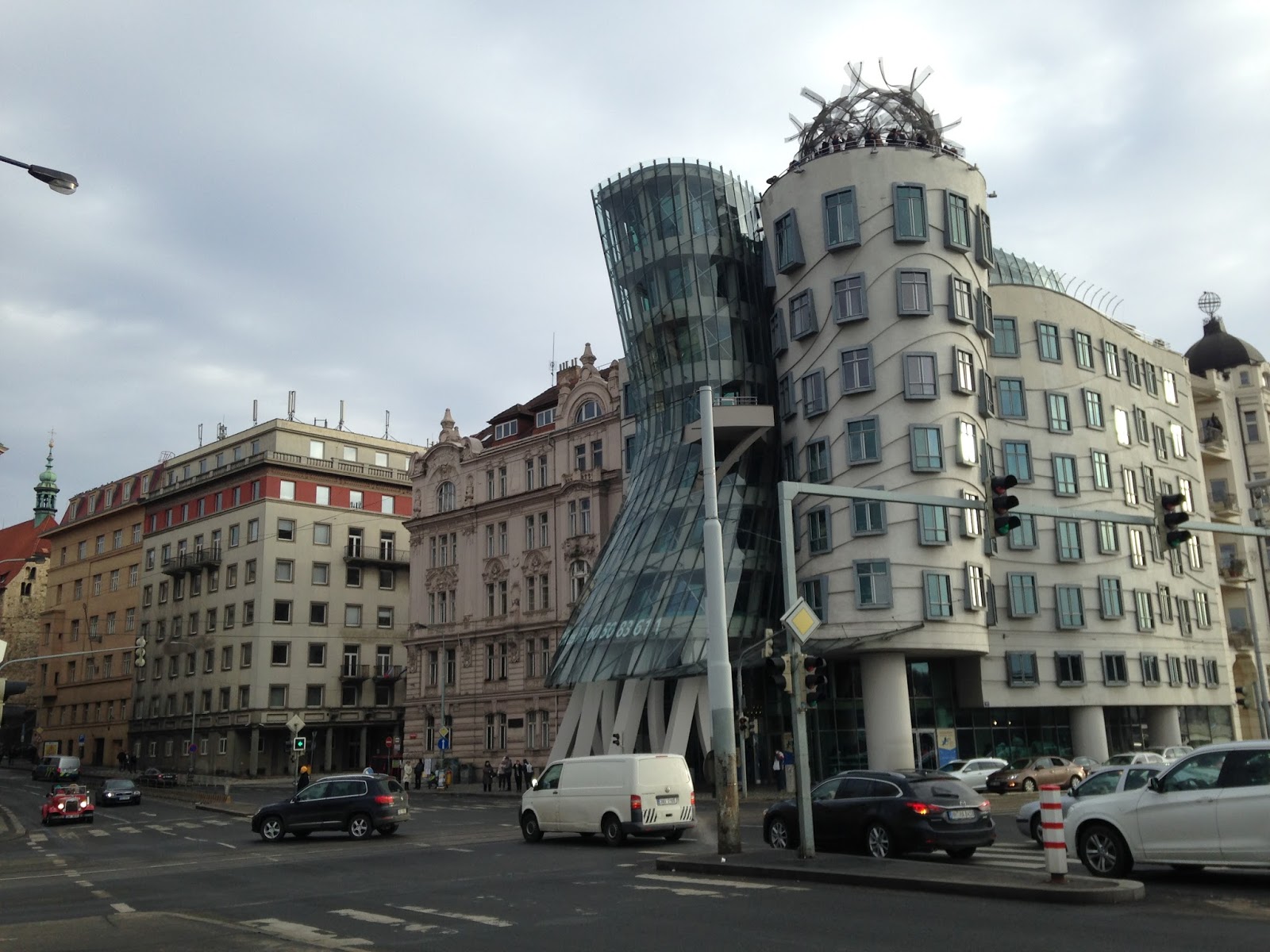
25: Prague: After the trip to Budapest we returned to Vienna and there I spent two more days after which my return journey began with a halt at Prague, the capital of Czech Republic. It was very cold and my experience in Prague was brief. The past few days, I was with a good companion so the Prague moment was lonely and boring. It was considered one of the most beautiful cities but the cold took all the charm and I didn't find anything special there in Prague than the normal busy European streets. What a closing journey for 2017.


Presumably, it was the last trip but I can see lights on more journey as the journey will never end. 


Sunday, 14 January 2018

Destination Europe X: London


"To London and Paris, 
I may not be able to take you,
But to all Bhutans sacred heritages,
I would take you on a pilgrimage." 

A Bhutanese song resonates in my mind whenever I travel around. Not that I am taking my beloved one to wonderous places but because of some fate and fortune, I could make the travels. Studying in Europe is full of opportunities and choices; the opportunities to intricately blend with the rich culture, explore the most historic civilizations, tour the cities and contemplate on the wonderful architecture and clean environments, learn new languages, meet new friends and of course immerse in the pool of knowledge. The choice is all ours as visiting places even as a backpacker is not so cheap. Staying idle in the school and totally immersing in our academics would not only enhance my knowledge but also help save some penny but then won't I regret once I get back to my home for not having seen Europe? I decided to explore on. Having visited Paris the year before, in December 2017, I could visit London. 
The Thames River and Tower Bridge

22. London: Because London cant be traveled on Schengen visa, its difficult to obtain the UK visa without a valid reason. I am glad to have come across a wonderful course on conservation at Cambridge and more glad, I got an assistance from Friends of Bhutan in Germany to pay the course Fee, which gives me the ticket to visit the UK. Yet unfortunate, the Visa application center in Berlin was closed and had to travel to Dusseldorf, a city which is 8 hours by train from my place, making it costlier. The UK visit visa costs 170 Euro processing fee and 30 more to ship the passport after processing. Travel and a night logistics in Dusseldorf cost 100 so its already 300 Euro expense before I got my visa in hand. However, the airfare to London was cheap as I could book the tickets much earlier in Ryan airlines, which flew me in less than 40 Euros. 

So 7th December 2017, my winter trip for 2017 started with the much-awaited travel to London. London, the capital city of UK is the most populous city and ranks 5th in the costliest city to live in Europe. Berlin, on the other hand, is ranked 38, no wonder how we are sustaining with a 750 Euro monthly stipend, and making numerous travels in between. Consumer price in Berlin is 18% lower than London. So, my embarking a 10 days journey to London and Cambridge will cost me a fortune as compared to my stay in Greifswald and visiting other cities in Europe. I flew from Shonefeld to Stansted and took a bus from Stansted to London which costs 10 pounds for the 1-hour journey. A three-hour journey in Germany costs only 11 Euros so I saw the aforementioned sharp contrast at first glance. Then followed the costs of city transports, hostels, and of course food. 

I planned two days sightseeing trip in London before I move to Cambridge so I am glad to have visited all the major points of interests in the two days. It was also an awesome feeling to see the snow falling while I was in London, but later realized it badly disrupted the transport services as my bus to Cambridge from London was delayed by 3 hours. However, here are some of the beautiful glimpses fo London through my Lens.


Buckingham Palace

House Guard Parade

The Street and Buildings

Trafalgar Square

Palace of Westminster

Westminster Abbey

London Eye


Madame Tussauds 

Kings College, Cambridge University

River Cam

Travellers Note: If the interiors of the monuments are not visited, a majority of the place of interests can be covered in a single day provided you take an Oyster card for city transport. Oyster card costs 5 pounds and one can recharge it with 10-20 pounds and use the card in all public transport services. If not a single journey will cost nearly 5 Pounds and it is expensive. For a backpacker and solo traveler like me, I save lots of time and don't leave the sites unvisited. My trip to Cambridge is covered through the post on the training that I attended there. The last two images are from Cambridge. 


Sunday, 24 December 2017

Destination Europe IX: Trip to Poland

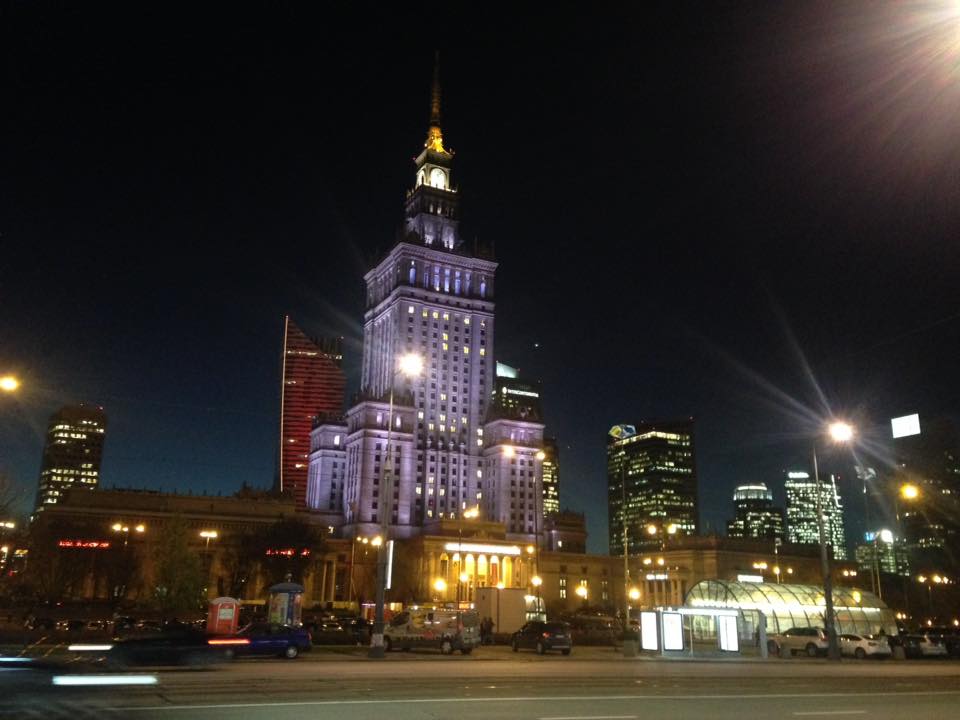
21: Warsaw: My trip to Warsaw was in October 30th. Unlike all my Euro tours, my trip to Warsaw was different in a sense that I was accompanied by my colleagues from the University. However the weather in Warsaw was bad. Bad to such an extent that there was a severe storm causing extensive disruption in railways and causing some deaths due to environmental misshapes. However we were lucky to have had a good glimpse of Warsaw old town during our second day. Some snaps taken at Warsaw.


Happy Birthday WeFie

Good thing about Warsaw is that the city is very cheap. Be it in public transport services or in restaurants and hostels, the rates are very cheap as compared to Germany, which makes Poland an easy destination for travelers. Pierogi is considered a national dish of Poland so my friend ordered a plate of Fungi Pierogi, which basically is like dumpling or momo. It was a good experience to eat momo in a faraway place. I didnt knew but later came to learn that one of our friend was having her birthday, which gave us a good reason to have some toast of cake with happy birth day greetings. It wasn't so well prepared one though. 

I was told by my other friends that city of Krakow is much beautiful than Warsaw but for me I am glad to have checked in the capital city of Poland. 

Saturday, 23 December 2017

Destination Europe VIII: Trip Italy Part II

18. Florence: The "cradle of renaissance" Florence is little more than 3 hours by bus from Padua, where I halted my last night after visiting the floating city of Venice. While in Florence, since I had only a half day, I make a random stroll through the city doing sightseeing. With limited time in hand, the best one can do is climb up to the Piazzale Michelangelo square and have a sizzling panoramic view of the city of Florence with its river Argo calmly flowing by its side. In the evening, since it is summer, days are long so its always fun to walk the streets, buy a beer and sit beneath the shades of the tall cathedral.
View of Florence from Piazzale Michelangelo

Florence and River Arno

Cathedral of Santa Maria del Fiore


Cathedral of Santa Maria del Fiore
19. Pisa: The next day I moved to Pisa only to have a glimpse of the leaning tower of Pisa. Once recorded as one of the seven wonders of world, every body know that the tower of Pisa leans but only by visiting the site does one realize how breathtaking the tall leaning tower is like. There are two beautiful churches near by it so for people having deep faith in churches, there is more than leaning tower at Pisa.

Leaning tower with two nearby churches

57 m Tower leans with 3.99 degree


20: Rome: I should have returned from Venice rather than spending more  money in travelling to other cities of Italy. But the famous quotes like "Rome was not Built in a day" and "While in Rome, do as Romans do" and vague histories that I heard of the great Roman empire tempted me to travel further south. Rome, the capital city of Rome has nearly 3000 years history of globally influential arts, architecture and cultural display. I just had a one single day in Rome so I made a point to visit all the points of interests in Rome. But this time, I had keen interest in the ancient ruins of the Roman Empire so made a paid visit to the Roman Forum, and the great Roman Colosseum. Vatican city, the headquarters of Roman catholic church and the smallest country of the world lies within the Rome.

Colosseum side view

The great Colosseum of Rome

Ancient Rome in Ruins and Present Rome City

Rome as seen from Roman Empire

Ruins of the Empire

Inside Colosseum 


Near the Spanish Steps


Vatican City Church.