Search This Blog

Showing posts with label Forestry and Natural Milieu. Show all posts

Monday, 15 June 2020

Spiritual Lakes of Jomolhari

In the vast remote mountains blessed by Guru Rinpoche, Jetsun Milarepa, Lama Drukpa Kuenley and Gyalwa Lorepa, are the two spiritual lakes. The turquoisetique Tsheringmai La-Tsho, the spiritual lake of Thseringma, the goddess of Wealth is located on the right side of the ridge facing down. The lake is situated at the base of Mount. Jomolhari (not from the tourist base camp), which also have numerous sacred sites, including the 12th century temple. It is believed that if environment around are defiled, natural catastrophes and destruction happen in the locality. People appease the deity by making milk and incense smoke offerings.
Thseringma La-tsho.


Facing down on the left is the, the La-tsho of Aum Jomo, the guardian deity of the Mount Jomolhari. Ulike the Tsheringma la-tsho bearing bright emerald blue colour with milkish stains, this spiritual lake bears greyish blue colour. The lake is situated on the left base of, what legend had passed on, the golden pillars that holds the main submit of Mount Jomolhari.

Aum Jomo La-Tsho

Aum Jomo La-Tsho

Sunday, 31 May 2020

Mount Jomolhari of Bhutan

Mount Jomolhari, rising at 7326 metres above sea level is one of the highest mountains in Bhutan. Jomolhari, also known as bride of Kanchenjunga marks the end of Kanchenjunga Mountain and is first amongst the series of mountains along the northern Bhutan. As majestic the mountains is, its base is spectacular and offer some of the best camping sites, pasture grounds, and pristine habitat for array of wild flora and fauna. It is also one of the ultimate sources of Pachhu, the river that drains the Paro valley.


Thursday, 13 December 2018

Biological Corridor No. 8 of Bhutan- A Corridor of Hope for the Tigers


The biological corridors (BCs) of Bhutan are conservation area set aside to connect one or more protected areas (PA) to facilitate wildlife movement. Eight in numbers and covering 8.61 percent of the total land area of Bhutan, BCs were first established in 1999, declared as a gift to the earth from people of Bhutan. With BCs added to the protected area network, today more than 50 percent of the country falls under the network known as Bhutan Biological Conservation Complex. Amongst other wildlife, the BCs are expected to enable safe migratory route for the tigers (Panthera tigris) between various protected areas in Bhutan.
Connecting Temperate Forests and Alpine Mountains- BC8 Landscape

Tiger is an iconic and charismatic species in Bhutan, which has great conservation significance both spiritually and scientifically. Spiritually, tigers are deeply revered in Bhutan’s Buddhist society with them featuring in many myths and legends such as the flying tigress of Taktshang (Tiger nest Monastry), the third animal of Buddhist zodiac, the four most powerful animals (the other three being Snow Lion, Garuda and Dragon which are all non-existent), etc. Tiger’s therefore, connects myth with reality. Tiger masked dances are portrayed during festivals, and are also beautifully painted on the walls of the buildings. Therefore, people in general have basic knowledge about tiger and have reverence towards it. On the ecological front, tiger is the largest carnivore found throughout Bhutan and play an important role in maintaining a viable ecosystem. Many conservation efforts are driven by tiger, thus serving as an important flagship species for the Himalayan kingdom.
The Location of BC8 in Bhutan

103 tigers were counted across Bhutan during the National Tiger Survey in 2015 but density were higher in certain pockets of the country. The tiger rich protected areas include Royal Manas National Park in the south and Jigme Singye Wangchuck National Park in central Bhutan. Wangchuck Centennial National Park, the largest protected area in northern Bhutan, on the other hand have fewer tiger number. The Biological Corridor No. 8 (BC8), which connects JSWNP with WCNP is therefore expected to help in enabling safe dispersal of tiger from the tiger rich PAs in south to the northern PAs. With tigers recorded at elevations as high as 4500 metres, WCNP despite most of its area being alpine region, have potential to hold more tigers than it does today.

Studies reported prey abundance as a strong determinant for tiger occurrence so with a goal to assess the structural connectivity of BC8, I conducted a field study using remote camera traps in the BC8 in the spring of 2018. Occupancy modeling was done for the primary prey species such as Sambar (Rusa unicolor), Wild boar (Sus scrofa) and Barking deer (Muntjac muntjiacus) taking into account various ecological and anthropogenic covariates. With one or the other primary prey species recorded in 65 percent of the total camera stations, the BC exhibited good occupancy of prey species. Species specific probability of occurrence for all three primary prey species were over 50 percent. Therefore, it is very likely that the existing pattern of prey occupancy will attract tiger to move through the corridor.

Interestingly, many of my camera traps also photo-captured tiger and upon careful examination of the tiger images, two tiger individuals were positively identified based on its unique stripping pattern. Predicted habitat use probability of tiger in BC8 from the study indicated possible habitat for the third tiger during the season, though I could not ascertain the tiger captured from that habitat as a unique individual as I could not obtain image of both the flanks of the tigers. Thus, the study affirmed that BC8 is indispensable for tigers either and their home range or for using as dispersal corridor. Also captured in the camera traps were four other wild felid species (common leopard, clouded leopard, Asiatic golden cat, marbled cat), Himalayan black bear, musk deer, serow, goral, etc.., stressing the need to protect the landscape.


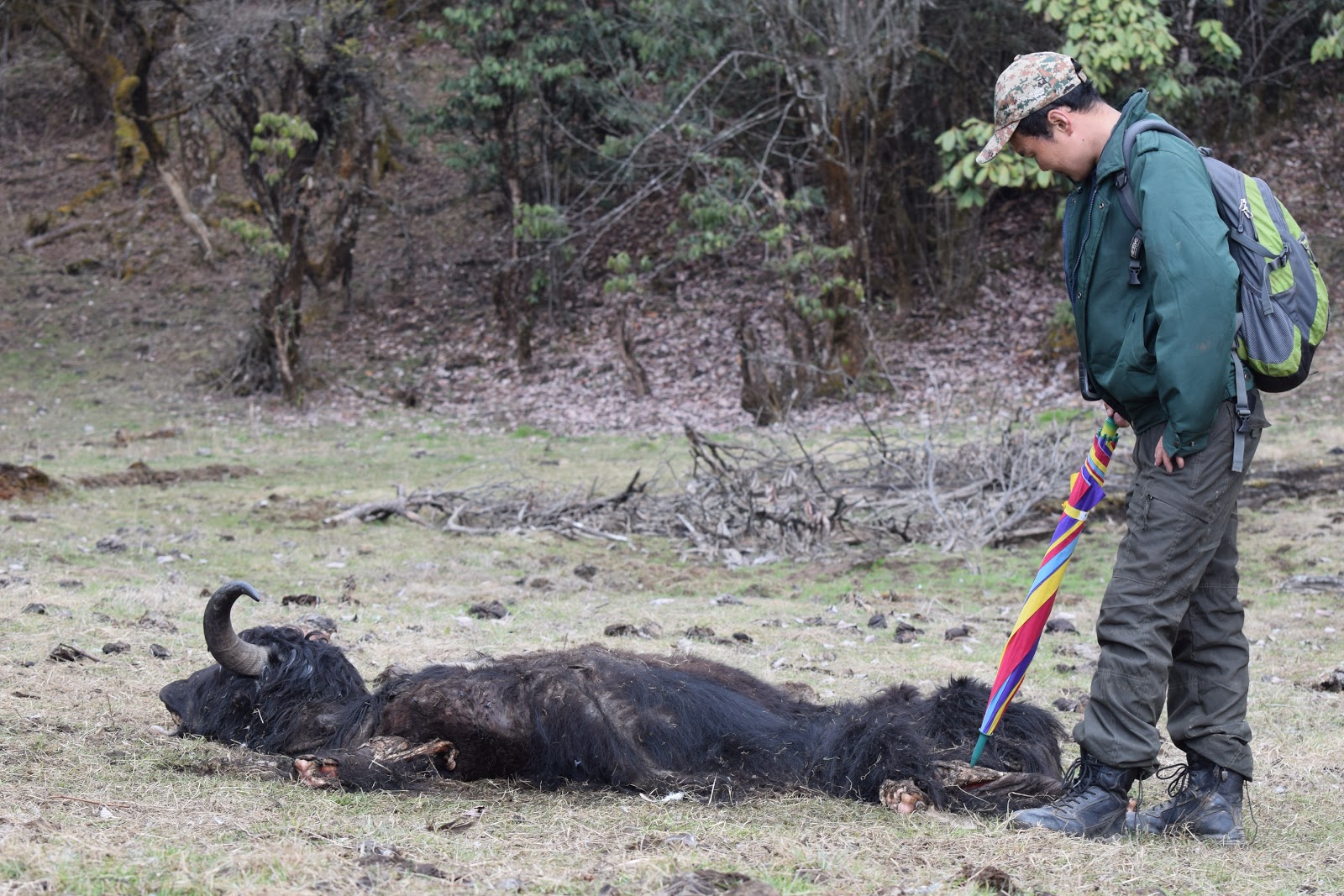
On the contrary, while the corridors were designed some decades ago, many people are still oblivious about the existence of it in their locality, which is an insult to the conservation practitioners. It only indicates the lack of conservation awareness education among the indigenous peoples. It was also disheartening to learn from the nomadic herders and agro pastoralists, how the tigers were a nuisance for them with tiger killing many of their livestock. For an instance, tiger killed 3 study yaks of Mr. Wangdi in a single season alone, and social interaction among the herders shared similar stories. This gives a clue that tigers are clearly fighting for their existence with dependency on domestic prey. Tiger’s unusual behaviour contradicting the probability of prey occupancy raises more question on what is wrong in the corridor and how to rectify it? While it was sad to hear about their losses, yet it was appealing to learn that there were no stories of retaliation in the region and people still have reverence for the animal, which in itself builds hope for the conservationist.
Author during the field work (T-1 Location)
As I accomplished the field work and looked into the results of my analysis, I felt the urgency in the need to educate the local indigenous herders about the concept of biological corridors to them and the crucial need for tiger conservation considering the current global threats and its risk of extinction. It is also equally vital to look into the depredation incidences and seek innovative mitigation measures so that we can transform the local people as partners of conservation. Tigers require large areas to establish their territories and as tiger population increases in the protected areas like RMNP and JSWNP, they will venture out. With the big cats dwindling in numbers across their ranges worldwide, Bhutan’s network of protected areas are providing safe haven for the species to thrive. Capturing tigers in the biological corridor strengthens our conviction that BC8 is already exhibiting its functional connectivity. With the concerned authorities looking seriously into social issues and heightening SMART patrols and constant monitoring, the Biological Corridor No. 8 will continue to remain a Corridor of Hope for Tigers and raises hope for other others in the landscape. Bhutan can ensure that this magnificent and fierce species does not blink out of existence.

Note: My research in the BC 8 was funded by the National Geographic Society, German Academic Exchange Programme (DAAD), with reassuring support from Department of Forests and Park Services (NCD and JSWNP).


Friday, 31 August 2018

Structural Connectivity of BC in Bhutan, an Abstract


The ability of animals to move across complex landscapes is critical for maintaining viable populations in the landscape. For an apex predator like the tiger (Panthera tigris), which is territorial and requiring large home range, habitat connectivity through biological corridors is vital. In Bhutan, the landscape conservation approach for tiger was initiated since 1999 when biological corridors were first established. Yet, the status of connectivity is not widely known. This study assessed the structural connectivity of biological corridor number 8 (BC8) for the tiger movements between national parks considering the ecological and anthropogenic variables influencing tiger and its prey. 

Camera trap datasets were used to assess the single-season occupancy of three principal prey species of tiger, sambar (Rusa unicolor), barking deer (Muntiacus muntjak), and wild boar (Sus scrofa), and to determine the habitat use probability of tiger. A questionnaire survey was administered to assess the current trends of human-tiger conflict, and people’s perception towards conservation. 

Barking deer had the highest occupancy estimate (ψ ± SE) 0.52 ± 0.09, followed by sambar (ψ ± SE) 0.49 ± 0.03 and wild boar (ψ ± SE) 0.45 ± 0.07. The influence of ecological and anthropogenic variables like elevation, aspect, slope, distance to river, and distance to settlement varied among the three prey species. Predicted occupancy map showed probable niche partitioning between species, thereby enabling better distribution of principal prey and thus the connectivity. Tiger habitat use probability was influenced positively by elevation and negatively by aspect and slope. Livestock predation was the prevailing human-tiger conflict in the area with tiger accounting 76.49% of the total kill in the past two years. Nomads were more vulnerable than agro-pastoralists, and livestock predation was higher during the winter. Over 80% of the respondents were not aware of biological corridors and over 30% perceived negative attitude towards tiger conservation and corridor management. 

The structural connectivity maintained by ecological variables and prey species would enable tiger movements across the BC8, but human-tiger conflict needs to be mitigated, and people should be educated for conservation. Management of the BC8 by developing the management plan remains the most pressing need. 

Sunday, 29 July 2018

Biological Corridor and Communities in Bhutan, Connectivity at a crossroad

Neither too low into the tropical jungles, and nor too high touching the alpine mountains, but in between are the temperate hills adorned with cool broadleaved forests and mixed conifer trees. Neither a sacred sanctuary of wildlife with strict protections, nor an edge facing the adversity of multifarious modern development, but it is the landscape with purpose; of maintaining diversity, of sustaining community, and most indispensably, of securing connectivity. They are the biological corridors (BCs) of Bhutan, set aside to connect one or more protected areas (PA) and facilitate wildlife movement, first established in 1999, as a gift to the earth from people of Bhutan. Eight in numbers and covering 8.61% of Bhutan’s total area, the BCs together with the PAs today forms the Bhutan Biological Conservation Complex (B2C2), expanding over 50% of the country.
Pristine Forests of Biological Corridor 8 connecting JSWNP to WCNP, as seen from Black Mountains of JSWNP

While the BCs together with the PAs create a beautiful mosaic of a conservation area in Bhutan, little is known about the actual connectivity enabled by the BCs. Conservation funds increased manifolds in the PAs but the indispensable BCs remained neglected. Wildlife thrived in the protected sanctuaries but their status remains ambiguous in the BCs. Park community livelihood was diversified but little did we know that communities at the fringes of BCs were trying their best for the sympatric association with the wildlife around them.  

With an objective to assess the structural connectivity of BC for enabling tiger movement between the national parks, I embarked on a new conservation journey in the spring of 2018. My priority amongst the 8 BCs was for BC8 that is the often called the northern corridor, as it connects parks of central Bhutan like Jigme Singye Wangchuck National Park (JSWNP) and Phrumsengla National Park with protected areas in the north viz, Jigme Dorji National Park, Wangchuck Centennial National Park (WCNP), and Bumdeling Wildlife Sanctuary. Further, I concentrated my work in the portion of BC8 that connects JSWNP with WCNP encompassing an area of 240 sq.km. JSWNP together with Royal Manas National Park (RMNP) was found to be home to around 27 tigers and are described as a potential source population for tigers. The tiger, despite having records of going as high as 4500 masl, the density is much lower in WCNP and its adjacent northern PAs. The sound management of BC8 is vital for population dispersal of tigers from RMNP and JSWNP to northern PAs. I, therefore, felt it’s vital that the structural connectivity is assessed soon, least we know the functional connectivity. Being a Landscape Ecology and Nature Conservation graduate student, I felt the responsibility has befallen me, thus I took the determination to set out.
Late March 2018, researchers marching in snow in BC 8 (3800 masl)

Late March, yet the winter doesn’t seem to have passed the temperate forests of BC8. The first night we were out in the forests and the next morning, we found that we were shrouded under the thick blanket of snow. I was accompanied by two research assistants and two field guides who also served as porters, traversing the hills and meadows which were yet to sprout. In Bhutan, field survey works are strenuous with no access to roads and we have to always hire porters. As per my study design, I am required to cover the entire study area of 240 sq.km within a short duration of one month, to assess the landscape structure, prevalence of large carnivores like tiger and to ascertain the occurrence of ungulate species which are proxy of landscape structure for enabling migratory corridor for large carnivore like tiger. While I will scan the entire area for indirect wildlife evidence like pellets and droppings of sambar or deer and scats of tiger and other felids, I also took along a score of camera traps to be set up for remotely triggering to capture the real-time presence of the species. Besides, I also had to meet many yak herders from the communities in and around the BC to hear their stories on wildlife and to know their perception towards BC and conservation, as I learned that the designated BC 8 is indeed core winter grazing sites for the nomadic herders in Sephu, Wangdue Phodrang. From May until October for six months, the nomadic yak herders move to their summer pasture in alpine meadows of WCNP.

While the snow made environment serene, it wasn’t really a perfect moment for a wildlife surveyor. The forest trails were slippery and there was no hope to find wildlife evidence with snow layering the ground. So I led my team to a community of nomads to hear their stories of herding yaks and encountering tigers. Amongst the nomads was Mr. Wangdi, with whom I had an intense interaction. At the age of 53, Wangdi is at his best with the chores that revolve around his 60 plus yaks, together with his wife and daughter. His winter grazing site falls completely within the BC boundary but he is oblivious of it. Indeed, Wangdi does not have any clue about what biological corridor is. However, he knows a good deal about the tiger and other wildlife. Wangdi has been interacting with wildlife since his childhood days and definitely, he would be familiar with wildlife as he is with his yaks. Out of curiosity, I asked him how often he saw a tiger live but he seems to have not seen it once. “The big animal is an emanation of our local deities so it will be always difficult to see,” he said. The tiger kills, as per their traditional belief, was often attributed to some karmic misfortunes in the family because he says that tiger kills the yaks of a particular family despite all neighbors freely leaving their yaks in the same open forests.
One of the Huts of Mr. Wangdi in BC 8.

Besides the tiger, there are other predators as well in the region. The wild dogs in pack hunt down big yaks and common leopards often take away the young calves. The Himalayan black bear, on the other hand, snatches the kill from tigers, as narrated by Mr. Wangdi. The landscape with forest connectivity hardly disturbed, and with the prevalence of diverse large carnivores, humans and livestock foraying into it means only the inevitable incidents of predation. It is, however, not a new phenomenon but for millennia, our farmers and wildlife have fared well in mutual coexistence. The nomadic herders in the region traditionally practiced Bon-Choe, a religious practice of believing in spirits and local deities with many ridges, trees, and cliffs declared as the abode of the spirits and deities and revering them sacred. Such practice instilled positive affinity towards nature and wildlife by the herders. Today as the shamanistic practice dwindled, herders understand the deeper Buddhist values and they have general abhorrence towards killing, being considered great sin. These are the major determinants of herders’ positive attitude towards wildlife, which enabled the human-wildlife coexistence.  But with changing times and in the face of increased depredation cases, the much-cherished ethic might face an abrupt end.
Chimmi, Wangdis daughter seen milking one of her Bjims.

Being a park official myself, I am aware of the efforts that conservationists put to build community stewardship towards the environment and make them conservation partners. I asked Wangdi if he was ever engaged in programmes developed by conservation agencies for the herders’ welfare but he looked awfully clueless. This was expected as the BCs received lesser priority for management as of now because of many constraints. Wangdi was quick to mention about an ad-hoc monetary compensation that he received for a number of yaks that he lost to tiger a few years ago. Wangdi feels that the tiger and other predators are increasing now with increased protection of wildlife. He lost three sturdy yaks to the tiger during the last winter, which accounts to an economic loss of around USD 1363 at the current market value. “It is a big loss for me and government is not consistent with monetary compensations,” says Wangdi, cautioning he might give up herding in the face of increased predation and better income opportunities. Monetary compensations, anyway were meagre in comparison to the losses that herders suffer.  Once, a normal acceptable phenomenon, his traditional belief is now replaced with expectations, and his age-old tolerance may soon see the substitution by arrogance. After all, why would a nomad care about the endangered species when he receives no tangible benefits of conservation in his backyard?

One of Wangdis yak succumbed to tiger injury in BC8, which was later feasted by bear and vultures.

By virtue of being a conservationist and a government official, it became my responsibility to share with him about the challenges that we face in pursuing conservation. Bhutan’s picturesque landscapes and rich biodiversity attracts high-end tourists, the revenue from which is shared by entire Bhutanese in the form of social services like free healthcare and education. Large cats like tigers are under constant threat from habitat loss and poaching, with the world population not more than 3800 individuals. Bhutan’s is lucky to harbour 103 of them, the number that thrived because of the harmonious coexistence between nature and our people. For a country like Bhutan, losing the tigers would also mean losing our rich cultural values. Tiger is the only animal that connects myth with reality in our Buddhist society. On the other hand, conservation in Bhutan is mostly donor-driven, and it is important that we make use of the fund in innovative ways than delivering measly monetary compensations. Biological corridors are vital for connecting the protected areas, therefore like people in the parks that foster to conservation needs, communities by the BCs will also form the ultimate connecting links.
The Stripe of BC 8 (May 2018)


The next three weeks, I continued with my field surveys and camera trap installation works, but recurring thoughts on the need to revive harmonious human-wildlife coexistence popped in my head. Neither do I want the landscape to be fragmented and tigers lost, nor do I want herders like Wangdi to suffer from predation and give up herding because sustaining both is a prerequisite of a vibrant connectivity. Will BC 8 serve as Corridor of Hope? 

Note: My research in the BC 8 was funded by the National Geographic Society and German Academic Exchange Programme (DAAD), with reassuring support from Department of Forests and Park Services (NCD and JSWNP).

Monday, 26 February 2018

Youths United in Rome Conference to Halt Deforestation

An important international conference was held at the FAO Building in Rome last week (20-22/02/2018), "Working across Sectors to Halt Deforestation and Increase Forest Area - from Aspiration to Action". It is important in the sense that world's forests continue to shrink as human population increases and forest areas get converted into agriculture lands and other uses, with a deforestation rate such that in next 100 years, there will be no forest left on earth. Today the global forest area is 3,999.00 million hectares. Forests through its complex ecological system, on the other hand, provides a multitude of services like provisioning of food, fibre, fuel and fresh water; regulating the quality of air and extreme climates; supporting varied species habitats and maintaining genetic diversity; and of course a set of cultural services through recreation, aestheticism and spiritual experiences. Halting deforestation is the most pressing need of the planet of today. 
When world is in unity, halting deforestation will be possible and forests cover will increase

Through the continued efforts of the office bearers of International Forestry Students Association (IFSA), it has been made possible for the youths to take part in this crucial conference and around 50 youth delegates were selected from all over to represent the voices of youths for halting deforestation, a common aspiration. By virtue of being a student in Europe, my age doesn't bar from myself considering the youth, and it was a wonderful privilege that I have been one of the few selected delegates to attend the conference. The coordinating team from IFSA has already planned such that youths will be engaged in a day-long training session to equip the youth participants both in person and via online for accelerating efforts to halt deforestation through discourses on what is causing it and what global actions need to be taken? It was also a platform where youths propose ideas and messages for High-Level UN Political Agenda. The aspiration is to ensure and built a moment that is intergenerational and cross-sectoral, and to make sure that our collective change brings together a cohesive planet and halt deforestation. 
Youth Delegates Post Session Business
The training that was divided into three parts was intense but enriching where the youths were not only given theoretical backgrounds on "Thinking Landscape" and "Gender in Resource Management" by the subject experts but also rigorously engaging us in the group works and exercises that yielded striking outcomes. There are conflicting interests among competing land uses, which is the main reason leading to alarming deforestation and hampering positive progress, therefore thinking landscape and acting landscape is one of the best solutions to resolve the conflicts. This can best be achieved through "Understanding the Landscape", "Engagement of Every Stakeholder", "Engaging the Institutions", "Creating Landscape Market Values" and  "Effective Management" of the all these components, knowing that they are indispensable for each other in an intricate web. While understanding landscape approach is vital for halting deforestation, it is equally vital to mainstream gender equality in resolving the issues. We understand the need for gender equality but often fail to understand the full complexity of gender and its relevance to natural resource management. Through the role plays, we could demystify the gender complexity and could identify the asymmetries in power distribution across different societal actors, thus providing new insights, tools, and resources for accounting gender dimensions in halting deforestation. 

Furthermore, the youths also excepted ourselves as an important stakeholder in the effort towards hating deforestation so we got introduced to the important policies like UN Strategic Plan for Forests (UNSPF), to mobilize concrete actions and map out tangible implementation strategies and actions for such goals. This is being reiterated on the need to engage youths in important policy discussions and high-level conference so that they can reflect on the key discussions and share their ideas for possible action. As the conference progressed further, many youth delegates raised questions and sought clarification in most of the sessions and often vigours of youth in the form of shouting while applauding and letting the panels rise to shake with tunes in name of shaking coconut tree. This being observed by the highest level of delegates like ambassadors to UN FAO, they recognized the need to engage youth in such conferences in the future too. Moreover, the key messages for youths and by the youths from the present conference are also expected to be part of the final draft of the key messages of the conference, which will be presented at the 13th session of the UN Forum on Forests, this May. This is one big impact the unity of youth delegates have brought for actions towards halting deforestation. 

Besides, a smaller group of youth delegates too formed themselves into core team and tailored the entire session of the day in concise and digestible 15-minute online discourse, which the many aspiring youths who could not attend the conference in person can view it. I was not part of the core team, and work burden was lower for me. I am amazed at the energy and enthusiasm shown by the youth delegates and I felt that even at national level conferences, there is a need to engage youths and let them understand the processes of formulating high-level policy plans for the compelling social and ecological issues, after all, youths are not only the future leader but the general mass of the future world, who will face the consequences of today's plans and policies. 


The Rome conference in general is in pursuant towards fulfilling Sustainable Development Goals 15, Life on Land, target 15.2, which calls for halting deforestation by 2020 and the UN Strategic Plan for Forests 2017-30 Global Forest Goal 1.1 that urges a reversal in loss of forest cover and increase forest area by 3% worldwide by 2030. I thank IFSA for accpeting my participation and sponsoring the trip. 


Saturday, 17 February 2018

Bhutan Radio collars her First Wild Tiger

Named, Tendrel Zangmo, meaning "auspicious omen"
Tiger collaring in process: (c) Kuensel
It was a pleasant surprise from a conservation hero and tiger biologist Dr. Tshering Tempa who is leading the tiger radio-collaring programme in Bhutan, when the news of the first tiger being collared made the headline in National Newspaper on the first day of the first months of Lunar Dog Year, Losar. A wonderful reason to celebrate the New Year and perhaps an "Auspicious Omen" for the future of tiger conservation in Bhutan. 

As per the new article, the tiger collared was a 3-year-old female, weighing 110 kgs and the team of foresters and Bhutanese biologists who made this major breakthrough in tiger conservation named her Tedndrel Zangmo, meaning "the auspicious omen". 

The tiger (Panthera tigris) is one of the largest carnivores in the world, with its range restricted in but widely spread across Asia, from Turkey in the west to the eastern coast of Russia. There are eight traditionally accepted subspecies of tigers but three subspecies were eradicated as early as the 1980s. Today there is less than 3200 adult tigers in the wild, spread across 7% of their historical range. They remain as one of the most threatened carnivores in the world and the species is listed as Endangered in the IUCN Red List of Threatened Species. Loss of habitat, habitat fragmentation and losing landscape connectivity, prey depletion, and poaching are generally recognized as key threats leading to the decline of tiger population. 
Tiger in Subalpine Mountains of Bhutan
Panthera tigris tigris, the Bengal Tiger is the subspecies of tiger found in Indian sub-continent and neighboring states including Bhutan. While tiger population elsewhere are facing serious conservation threats, Bhutan's deep-rooted conservation ethos and reverence for tiger as one of the mystical creatures, have provided a safe haven for this animal to thrive. Conservation is further boasted through the visionary policies of our great Monarch with constitution mandating 60% forest cover for all the time to come, and designating over 50% of the country as protected areas and biological corridors. Through this conservation landscape, tigers roam between the country's subtropical jungles at an elevation less than 100 metres above sea level (masl) in Royal Manas National Park in the south to sub-alpine mountains as high as 4400 masl in Northern Wangchuck Centennial National Park. Therefore, Bhutan is the only tiger range country where Tiger and Snow Leopard habitat overlaps. Tiger is strictly protected under Scehdule I of the Forests and Nature Conservation Act of Bhutan 1995, and people guilty of killing tiger are liable for a hefty fine of 1 million Ngultrum (15500.0 USD approx.). 
High-Resolution Image of Wild Tiger in Bhutan
On the forefront, foresters of Bhutan guard the tigers through intensive antipoaching patrolling using SMART tools and nation embarked to count the tigers using camera trap technology in 2014 and completed the survey successfully in 2015, counted 103 adult tigers with a density of 0.23 tigers per 100 sq.km. This is one of the significant findings in Dr. Tempa's work for this Ph.D. programme, which showed to the world that Bhutan can play a significant role as tiger source sites, in global tiger recovery programme of doubling the tiger number in the world by 2022, from the baseline of 2010. Bhutan otherwise was not included in a popular tiger conservation approach of securing 6% of the total tiger habitat as tiger source sites. While such findings are vital for letting the global community know of Bhutan's tiger conservation efforts, for the Bhutanese conservationist and biologists, it is our solemn duty safeguard our natural heritage with rich biological diversity and pass down to our younger generations, as did by our forefather to us. Successfully collaring Tendrel Zangmo under the leadership of Dr. Thsering Tempa, our own tiger biologists and programme director of Regional Tiger and Cat Research Centre in Bhutan, is but a testimony that we as conservationists can move with the global pace in using modern technologies in conservation, and address the challenging issues. 

Tiger collaring team back in 2015, off to field.
The radio-collared tiger has a transmitter attached around its neck, which sends the Global Positioning System (GPS) coordinates every hour and the data will be recorded by the receiver by the researcher at the station. The data thus obtained can be very beneficial in understanding the movement pattern of the tiger, the use of migratory corridors, actual home range, etc., which in turn will help in identifying conservation interventions including mitigation of human-wildlife conflict, and preventing g poaching incidents 

I had the privilege of being in the core team of Tiger Radio Collaring Project when the maiden radio collar programme began in Royal Manas National Park in November 2015. A team of dedicated foresters, also led by Dr. Tempa tried our best effort to capture one but without success. Perhaps the time was not right then so it is awe-inspiring to learn that it has been a success this time; a great milestone for now and a great opportunity ahead. Congratulations to the Team. For me, it's a wonderful opportunity to have worked with a great tiger biologist of my times at home and have constant guidance and support from him, Thank you Dr. Tshering Tempa.
Letro: Twitter

P.S: I made a tweet of the news report and amazed to see my tweet getting the biggest toll of retweets and likes by the enthusiastic conservationists and feline lovers from worldwide. The news seems to have simply awed them. 


Saturday, 6 January 2018

A Promising Journey for 2018

The 2018 has kicked off and a week has already passed by. And if a new year resolution was set, it should be clear by now, whether we are in the right direction in achieving the goals of the year. I don't have resolutions as such for 2018 but as I look forward into 2018, there are lots I have to accomplish and it will definitely keep me busy most of the time. It is a peaceful beginning for 2018 for me and as I take up the further journey, I look forward a peaceful ride, but of course with challenges that will alter me into better form. 

As u set into wilderness, appease the deities.
(Towards Black Mountains in 2015)

This is my third semester of my M.Sc programme and I am quite relieved to have completed majority of the electives in the first two semesters. This leaves me with more time for completing a basic module and planning for my final semester, that is exclusively for Master Thesis Works. So basically I don't have to prepare for exams this semester but have to present my Research Internship Protocol, which is in line to my Master Thesis Works. I aspire to complete the presentation by end of this month or early February and leave some free time for myself to aptly plan my field work. 

Being Landscape Ecology student, I wanted to do my thesis research on a title encompassing landscape conservation and I am glad to be doing on a title "Assessing structural connectivity of Biological Corridor for tiger movement between National Parks in Bhutan." With support from my mentors and professional guardians at home and my supervisor here in the University, I am glad to have secured the Early Career Grant from National Geographic Society, which puts me in a safer side without having to worry about research funding. But more than the fund, I am glad to be amongst the few NatGeo Explorers from Bhutan. Being DAAD scholar, I am also glad to have my proposal and travel plans accepted by DAAD and got the travel grant approved well in advance. I am already set to fly back to Bhutan by Mid march for the following three months. 

So, I see a switch in my travelling this year unlike in 2017 where I traveled extensively in Europe during my free times. 2018 will pull me back to wilderness and I am already excited, firstly because I have been away from home for over one and a half year and secondly, I am quite excited with my field work to have some interesting findings. Unlike my solo trips of 2017, my trips into wilderness for 2018 will require the support from various offices of the Department of Forests and Park Services, and I am being optimistic that right field colleagues would be in my wild expeditions to gather some good data for writing my thesis, and of course contributing little efforts towards conservation in Bhutan. 

Each year, I have been trying to attend one international conference for all the benefits that it gives. The Global Landscape Forum 2017 at Bonn was a gratifying experience and for 2018, I am trying to attend the 10th World Dendro Conference in Thimphu. I have already planned such that I can attend in full and then return back to Germany and I really look forward it after tiring field days. 

That will leave me with limited time to complete the requirements of my Master Thesis as I plan to graduate by Mid September and safely land back home to rejoin my service at JSWNP. Hush! that's going to be a fast race but I will be glad because I would have achieved the Master of Science from University of Greifswald. And I hope that JSWNP welcomes me back in good spirit so that I can contribute to the great works that my colleagues are already doing, and may be add some extra impetus. But definitely, the future is going to be an opportunity. 

Well, 2018 is yet again going to be a remarkable year for Bhutan. We are progressing into the Third Parliamentary Elections and Bhutan will definitely have more talks on politics than ever. I am glad that I would be able to vote in person this time for both National Council and National Assembly elections and that in itself is a great responsibility for me. We would be probably having our NC elections in April and NA elections in September-October. This years NA elections seems to become more competitive based on the current flow of news on social media but I should be mindful in voting for a party that will best benefit the country with innovative current developments and long-term sustainable policies. My conscience should be able to judge the parties well and should vote intelligently. As a civil servant, we should remain apolitical but I feel civil servants should also raise their voices with regards to party politics for the betterment of the nation because Civil Service is the biggest pool with educated lots who, if not swayed by corrupt practices can think better for the country. Any way, who ever wins, I would be striving my efforts towards conservation until next election and further, as deemed necessary by the bound with RCSC. But any way conservation of nature is something every human should contribute in this anthropocentric era. It is a collective responsibility. 

So 2018 looks promising and all I need now is to sail with the tide. 


Saturday, 16 December 2017

Professional Training to Enhance Professionalism in Conservation.

Short-term professional training courses are vital not only for the agencies to enhance their efficacy but also for the personal growth of an individual professionally to become even more valued member of the team. Occasional participation of the employees in various need-based professional training will also prepare him/her for professional advancement within the agency, which helps tackle the issues arising within the agency. In Bhutan, we are lucky have our visionary monarchs who have provided unprecedented leadership to take the country forward. Within our civil service, we are more lucky to have this system of nurturing the employees by giving them opportunity to pursue numerous workshops and training both within and outside the country. Such need of professional development are recognized by His Majesty the King himself and gives more emphasis on individual professionalism and leadership as stated "What we need is not a leader to lead the masses - we need leadership of the self." Realizing the need to regularly update the professional knowledge of the individuals in the the complicated, globalized and sophisticated world, and to tackle the emerging challenges with innovative ideas and solutions, Bhutan are lucky to have institution such as Royal Institute for Governance and Strategic Studies established as envisioned by His Majesty the King, which now provide high quality education and discourses to our leaders at different stages. Therefore, there is no denying to the fact that professional development opportunities of varying degree is necessary for every individual in the agency.  

When I first joined my professional career as Forestry Officer at JSWNP after my undergraduate studies, the first task assigned to me was take up managing the then existing conservation project. The professional knowledge that I obtained from the University were diverse but were mostly related to my field of study, that is Forestry. I doesn't have a vague idea of how project should be managed, its reporting protocols, the monitoring and evaluation and most importantly maintaining the much needed healthy relationship between donor and our agency. Constant guidance from the immediate leader is deemed necessary to get myself groomed and nurture into an effective employee. My boss, realizing the paramount role that I was playing in managing the conservation project, have given me the opportunity to enhance my professional knowledge in species conservation and monitoring at the Smithsonian Institutions in USA in my second year of service. 

While initially I was only excited to go out and get better exposure, I instantly realized the investment that is being put in me, I could feel the heavy weight coming along with the opportunity. I was also given with the privilege to get myself trained in Tiger radio collaring process at a Wildlife Sanctuary in Thailand by the Ugyen Wangchuck Institute for Conservation and Environmental Research, but unfortunately our implementation of the same failed back at home despite our rigorous and enthusiastic effort to radio collar tiger for a month in Royal jungle of Manas. Hon'ble Director General of the Department was also being farsighted enough to have young officers attend the dialogue of conservation when I was a part of delegation lead by HE the Agriculture and Forests Minister during the 3rd Asian Ministerial Conference on Tiger Conservation. Besides, I also availed many in country training and workshops within the short duration of three and half year service. Being an early career conservationist, the professional training were a strong impetus for me to perform  better, and I have the contentment that I gave my best professional commitment, of course excepting certain degree of follies in my working nature. Personally, each training and certification were always a way to built up my resume and get myself advanced with more value addition. 

Today I am glad to have attended a professional training offered by the esteemed Durrell Conservation Academy, an institution that strives to save species from extinction. Since my first hands on job entailed dealing with conservation projects, I was very keen to attend this course and I am glad I could make to it. The course was designed to strengthen the project management and leadership skills of conservation and natural resource professionals. The five day training held at the much David Attenbough building of Cambridge Conservation Initiatives touched various aspects of personal leadership and management skills, team forming and team decision, project formulation, monitoring and evaluation, risk management and dealing with failures, and many more important aspects. It helped me look back into my past experiences for contemplation and incorporate the new lessons in my upcoming research projects. The course shows direction to early career conservationists for for managing and leading conservation projects. 

I was able to attend this training through the financial support rendered by German Bhutan Himalaya Society and I remain indebted to its members, who are more than Friends of Bhutan. My special thanks are due to Mr. Reinherd Wolf, the President of the Society for facilitating with my proposition. I also thank the course instructors from Durrell and Fauna & Flora International for being so generous in sharing their expertise.  

Upcoming quality professional training can be found at (click on the links) Smithsonian Institutions and Durrell Conservation Academy.


Sunday, 16 July 2017

Seeing wildlife through hidden eyes: A decade of wildlife camera trapping journey

"As we are nearing to the celebration of the big day, World Rangers Day 2017 on 31st July, I have the pleasure of sharing this personal narrative of my close friend, field companion, my guide to wilderness, a very sincere and dedicated Forester from JSWNP, with whom I set out to field for the first time setting up camera traps, and together we didn't look back. From the tropical plains of Manas in the south till the final ridges of Passamlum in the remote northern mountains, and of course not leaving a nook and cranny around our own Jowo Durshing, we explored the wilderness together in bliss. Mr. Dorji Duba is truely inspirational at least to me."

November in Manas is bliss. The scorching heat of the summer will subside and the mighty Manas River as it flow down swiftly, it would leave behind a chilly breeze making the environment calm and soothing. We at Manas Park Range campus would have a wonderful evening stroll through the woods and along the river banks, enjoying the beauty of nature that shroud us.  Manas despite its unbearable tropical weather in the summer, is a safe haven for all kinds of wildlife including Royal Bengal Tigers, Golden Langur, Great Hornbill, Wild Buffaloes, Guar, and several other prey and predator species. We the foresters are savior of it. One afternoon of November in 2006, we had special guests from Thimphu, a team from Nature Conservation Division (NCD) accompanying a conservation scientist Dr. Yogannan from India. I learnt that they were there to train us how to conduct camera trapping for wildlife survey, a technique I never heard before. The news was so exciting that out of curiosity, I couldn’t sleep the whole night that evening. Imaginations of how camera would automatically capture pictures in the forests and worries of how we keep the camera safe in the wild popped up in my mind. The next morning, no sooner did I finish the breakfast than I set off to excitedly wait for the camera trapping lessons, which were to be taught to us. Sighting of a small boxlike structure brought amusement in me. Then, I didn’t realize it would become my ultimate tool in wilderness.
Duba guiding one of our friends with the settings in camera
 The whole day we were taught the principles of how it work, how we should handle. For many years, I was a forester with hammer and gun as my sole weapon but I could see new tools coming. Global Positioning Systems (GPS) was not so common until I handled the camera traps, another important equipment for the foresters. During my countless journeys in the wild, I have encountered numerous animals and never saw a tiger or other cats. With the new tool, I could see myself photographing tiger and many other wild animals which I didn’t have a clue about their existence.  The next day early in the morning, we had practical session and that was the day I mount the camera trap in the forest on a suitably selected trail for the first time. It was just a beginning.
At Tsokar Tsho at 4300 masl, way to Pssamlum, Bhutan-China Border

My fate compelled me to join Bhutan Forestry Institute in Taba back in the spring of 1999, having strived hard to complete by 10th standard all on my own. It was fateful because despite having a will to study further, every single dream of mine was shattered when my parents divorced without any mercy to me and my younger brother. Then, my objective of joining BFI was to get a job as forest guard to sustain my living and help my brother because that was one gateway that required the least qualification. BFI made me a Forester but I didn’t dream I would become a camera trapper or camera trap specialists with the leading national conservationists and tiger biologists.

 Exactly a month later, Dr. Sonam Wangyal Wang from NCD visited us with a different set of cameras and taught us his way of setting up the camera traps. Besides my usual patrolling works, I embraced that new adventure of going into wilderness with camera traps. I am quite fortunate that such camera trapping exercises came one after another and always had a place for me. In 2008, I joined the camera trapping expedition of Dr. Tshering Tempa and I saw myself more advancing with the camera trapping techniques. However, camera traps have also evolved from simpler Cuddeback and higher resolution Reconyx cameras.  Days during the installation of camera traps are so challenging but when I see the results, I get more motivation to work harder.
Somewhere in the wilderness of WCNP, Duba gaze over the lowlying tiger habitats.

During my early career life, I was least bothered about the diversity of life in forests, their habitats and habits. I was only concerned with hammering and doing patrolling works, which became monotonous. It was the new camera trapping adventure that injected more curiosity in me into the secrets of nature’s beauty. I studied the animal signs and evidences, I studied the diversity of plant lives, and I photographed birds and butterflies. I saw myself growing more passionate towards nature and I realized that these little efforts of mine were having a bigger impact for conservation.

In the summer of 2009, RMNP hosted a very big crew of wildlife enthusiasts from BBC Natural History Unit. RMNP was required to deploy some foresters having wildlife and camera trapping knowledge with the visiting team. My boss have then already recognized me was asked to accompany the team. I was more than lucky because the team comprised of experts in every field and they were with many sophisticated camera equipment, as they were making a documentary of biodiversity with special focus on tigers, which later they produced the renowned documentary, the “Lost Land of the Tiger”.
Duba, in one of his many attempts to submit Black Mountain top while conducting surveys.
(A post on his journey to the Black Mountain coming soon.)

In 2011, I was transferred from RMNP to Jigme Singye Wangchuck National Park (JSWNP). I once thought that my adventures would be coming to an end, as JSWNP have more human settlements and I would be busy marking the trees and patrolling the forests. However, luck has it that JSWNP was yet to implement their first ever WWF funded project, in which many wildlife surveys using camera traps were a component. I was initially placed at Khebethang Centre in Phobjikha but my then Park Manager, Mr. Kelzang Wangchuk asked me to come to the park head office in Tshangkha. While In Tsangkha, I was assigned with the lead role to conduct the entire camera trapping works of the project. In September 2012 I completed the Mammal Survey and recorded the presence of 22 mammals. In 2013, I completed the camera tapping works Biological Corridors that connect JSWNP with Jigme Dorji National Park (JDNP) and Wangchuck Centennial National Park (WCNP). While I was busy with these surveys, Dr. Tshering Tempa (then Ph.D student) approached JSWNP for his Tiger-prey dynamics study. However, we also had to complete the Tiger Survey in JSWNP so together with UWICE team I along with my friends from JSWNP have set up and monitored over 60 camera traps stations from April 2013 till June 2015. By then we have recorded the presence of 12 individual tigers in JSWNP, tigers going as high as 4200 masl, gaurs approaching nearer to Black mountain at elevation of 4180 masl, 7 species of wild felids and a new record of 39 mammal species, excluding the bats and small mammals. It was also in JSWNP that I had the privilege of attending more training on camera trapping and data management. I also availed my first study tour abroad, i.e Bangkok in 2012, after serving for 13 years.

Yet before I was done with the works in JSWNP, the much awaited National Tiger Survey was planned. I along with two friends from JSWNP was nominated for the National Tiger Survey in January 2014. By then I saw myself more in forests than at home, sometimes stretching over a month. As a part of National Tiger Survey Team, I was assigned to complete the most challenging sites where there are not many friends who handled camera trapping.  The work was huge for me even then I managed to cover the areas of  Nanglam, Shingkhar, Loweri, Jomotshangkha, Martshala and Sonamthang under Samdrupjongkhar Division, Dagala under Tshirang Division, Dangdung, Chala, Simphu and Segtang under Bumthang Division where I could contribute the Tiger not less than anyone. Meanwhile UWICE has called two of us from JSWNP for setting up special camera traps in mountains of WCNP in June 2015. I spent around 26 days in the mountains installing over 40 cameras to the places which were never explored by people. We retrieved the cameras after three months in September 2015. I learnt how we should set up cameras in different ecological conditions.  At times, I was so worried about the functionality of my cameras because my camera traps were running in many different places at a same time. However, as the department published the National Tiger Survey Report 2015, I was so happy to see many tiger which my camera traps have captured.
An illusive alpine cat caught in Dubas camera trap.

Over 11 years, I had explored many secret corners of the country and captured thousands of wildlife images, which is in one way a pride for me. To capture a Tiger is not as easy as we think; we are smart and cameras are smarter but Tiger are smartest. If we need good tiger picture, it is necessary to explore the area and know the subject behavior like where they prefer to walk. Each journey gives us new lesson and the more hardship we take the better the result are on our way. Yes! I did it, satisfaction is always there. We have to do the work with interest but not under compulsion; if we have interest it will not take time to learn and there will be no obstacle to block our track. 

The king of the jungle, image from one of Dubas camera trap in JSWNP

The interesting thing about camera trapping is that we capture the tiger at RMNP and then we capture the same tiger at JSWNP. We find our tiger captured in RMNP in the mountains on JDNP after 5 years, which is so amazing. From that we know where the Tiger belongs and how much area the tiger have covered. Science of conservation begins from our forests. As I reflect on this journey of camera trapping works, I still have my camera traps running in JSWNP and in the Biological corridors. A part of me is always looking after the wildlife, in the darkest of hours and extremes of weather. I express my sincere thanks to all who trusted me with the tasks and gave me the opportunity to work.

Dorji Duba
Forester,
JSWNP
dorjiduba@gmail.com

This story featured in the June 2017 edition of the RNR Newsletter. 
 The pictures are bloggers collection, until otherwise referenced.